
The Next Global Environmental Crisis Is Invisible: Why the World Needs Environmental AI Governance
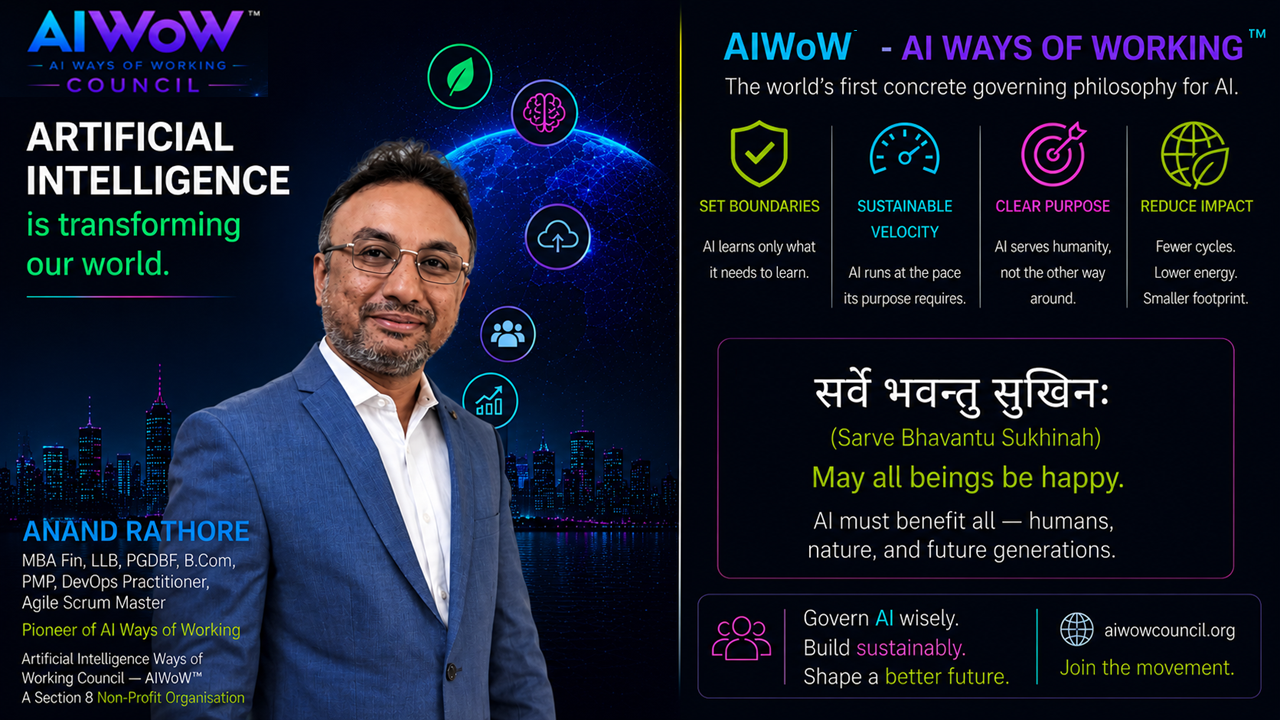
By Anand Rathore
Author of AIWoW – AI Ways of Working™, designer of the AIWoW Framework, and Founder of the AIWoW Council
The world is witnessing the fastest technological transformation in human history. Artificial Intelligence is redefining healthcare, education, agriculture, finance, manufacturing, governance, scientific research, and almost every profession. Within just a few years, AI has evolved from a supporting technology into a strategic driver of economic growth, innovation, and national competitiveness.
Yet amid this extraordinary progress, humanity is overlooking one of the most significant challenges of the AI era.
The greatest environmental threat is not Artificial Intelligence itself.
It is ungoverned Artificial Intelligence.
Unlike industrial pollution, AI pollution is invisible. It produces no smoke, no contaminated rivers, and no visible waste. Instead, it quietly consumes electricity, freshwater, computing infrastructure, rare earth minerals, and electronic hardware through billions of AI computations occurring every day across the globe.
Artificial Intelligence has become the world’s fastest-growing consumer of computational resources, but very few organizations measure its environmental footprint.
According to the International Energy Agency (IEA), data centres consumed approximately 415 terawatt-hours (TWh) of electricity in 2024, accounting for nearly 1.5% of global electricity demand. By 2030, global electricity demand from data centres is projected to increase to around 945 TWh, with Artificial Intelligence becoming one of the primary drivers of this unprecedented growth.
These numbers should concern every policymaker, every business leader, and every citizen.
Electricity is only part of the story.
Modern AI systems require extensive cooling infrastructure. The United Nations has estimated that AI-related infrastructure could consume between 4.2 and 6.6 billion cubic metres of freshwater annually by 2027, creating additional pressure on water resources in many parts of the world.
Research highlighted by the Massachusetts Institute of Technology (MIT) further explains that while training large AI models requires enormous computational resources, the cumulative environmental impact of billions of daily AI interactions is becoming equally significant. Every prompt, every generated image, every automated workflow, and every AI-assisted decision contributes incrementally to global energy consumption.
Ironically, Artificial Intelligence also has the power to help solve climate change.
AI can optimize renewable energy, improve precision agriculture, predict natural disasters, monitor biodiversity, reduce industrial waste, optimize transportation networks, and accelerate scientific discovery.
The same technology that can protect the planet can also increase pressure upon it.
The difference lies not in Artificial Intelligence itself.
The difference lies in how humanity governs Artificial Intelligence.
Today’s AI governance discussions focus primarily on ethics, privacy, transparency, fairness, cybersecurity, intellectual property, and regulation.
These discussions are necessary.
However, one critical pillar remains largely absent.
Environmental AI Governance.
Who measures unnecessary AI computation?
Who evaluates redundant model development?
Who determines whether AI should be deployed at all?
Who assesses whether organizations are consuming ten times more computing power than necessary to achieve the same business outcome?
Today, there are few globally accepted answers.
Most organizations measure AI success through productivity, automation, revenue growth, customer experience, or operational efficiency.
Almost none measure AI success through computational efficiency, environmental sustainability, energy optimization, model reuse, infrastructure utilization, or lifecycle governance.
This represents a significant governance gap.
History teaches us that every technological revolution eventually demands new governance.
Industrialization transformed civilization but later required environmental regulations.
The automobile transformed transportation but required traffic laws.
The internet transformed communication but required cybersecurity and privacy frameworks.
Artificial Intelligence now requires its own evolution in governance—one that includes environmental responsibility alongside innovation.
Through my research and the AIWoW (AI Ways of Working™) framework, I propose that organizations must shift their attention from merely adopting AI to redesigning how people, processes, leadership, governance, and AI work together.
AI transformation is not fundamentally a technology problem.
It is an organizational design problem.
Many enterprises unknowingly generate enormous computational waste.
Multiple departments procure similar AI solutions independently.
Models performing nearly identical tasks are repeatedly trained.
Experimental AI pilots continue long after their business value has disappeared.
Cloud infrastructure remains active despite minimal utilization.
Employees increasingly depend upon AI for routine activities that could be performed more efficiently using conventional software.
Each individual decision appears insignificant.
Collectively, they create invisible environmental pollution.
AIWoW proposes that organizations should establish structured Artificial Intelligence Ways of Working that integrate governance, leadership, accountability, sustainability, human capability, and continuous improvement into everyday AI operations.
When organizations improve governance, they naturally reduce unnecessary computation.
When they strengthen leadership, they improve AI decision-making.
When they redesign business processes, they eliminate duplicate AI workloads.
When they develop human capability alongside AI capability, they create more sustainable organizations.
Better organizational behaviour ultimately produces better environmental outcomes.
Building upon this philosophy, I propose the concept of Environmental AI Governance (EAIG).
Environmental AI Governance extends traditional AI governance by integrating environmental accountability throughout the AI lifecycle.
It asks questions that organizations rarely ask today:
Should this AI solution exist?
Can an existing model solve the same problem?
How much electricity will this deployment consume?
What is its estimated water footprint?
Can infrastructure be optimized?
Can unnecessary computation be eliminated?
Can AI create greater value with fewer resources?
The Organisation for Economic Co-operation and Development (OECD) has similarly emphasized that measuring AI’s environmental impact requires broader indicators, including electricity consumption, infrastructure efficiency, hardware lifecycles, reporting transparency, and sustainable operational practices.
Encouragingly, research supported by UNESCO indicates that thoughtful improvements in AI model design and deployment can dramatically reduce energy consumption while maintaining useful performance. This demonstrates that sustainability and innovation are complementary—not competing—objectives.
However, governance cannot be achieved through regulations alone.
It requires education.
It requires awareness.
It requires collaboration.
It requires institutions dedicated to responsible AI.
Recognizing this need, I founded the AIWoW Council (Artificial Intelligence Ways of Working Council) as a nonprofit organization committed to promoting responsible, human-centred, and environmentally sustainable AI adoption.
The Council’s mission is to advance research, professional education, awareness, certification, collaboration, and policy dialogue that help organizations implement AI responsibly. Through conferences, publications, educational programs, industry partnerships, and community engagement, the Council seeks to build practical capabilities for governing AI in ways that benefit both society and the environment.
Responsible AI cannot remain the responsibility of governments alone.
It must become a shared responsibility of enterprises, universities, researchers, engineers, policymakers, project managers, CIOs, business leaders, and citizens.
India has an extraordinary opportunity to contribute to this global movement.
Our nation has become a global leader in digital innovation, software engineering, and technology services. The next opportunity is to lead in AI governance by demonstrating that technological excellence can coexist with sustainability, ethics, transparency, and human development.
The twenty-first century will not be remembered simply for building intelligent machines.
It will be remembered for whether humanity governed them wisely.
Artificial Intelligence has the potential to become the greatest accelerator of human progress ever created.
But progress without governance has repeatedly produced unintended consequences throughout history.
The future therefore belongs not merely to organizations that deploy the most AI.
It belongs to organizations that deploy AI responsibly, efficiently, transparently, sustainably, and with clear ways of working.
The world does not need less Artificial Intelligence.
The world needs better governed Artificial Intelligence.
And the journey toward that future begins with one fundamental realization:
Artificial Intelligence should not only become more intelligent.
It should become more accountable—to humanity, to society, and to the planet we all share.